
DON’T DONATE UNTIL YOU ASK THIS QUESTION
GOOD INTENTIONS ARE NOT GOOD ENOUGH
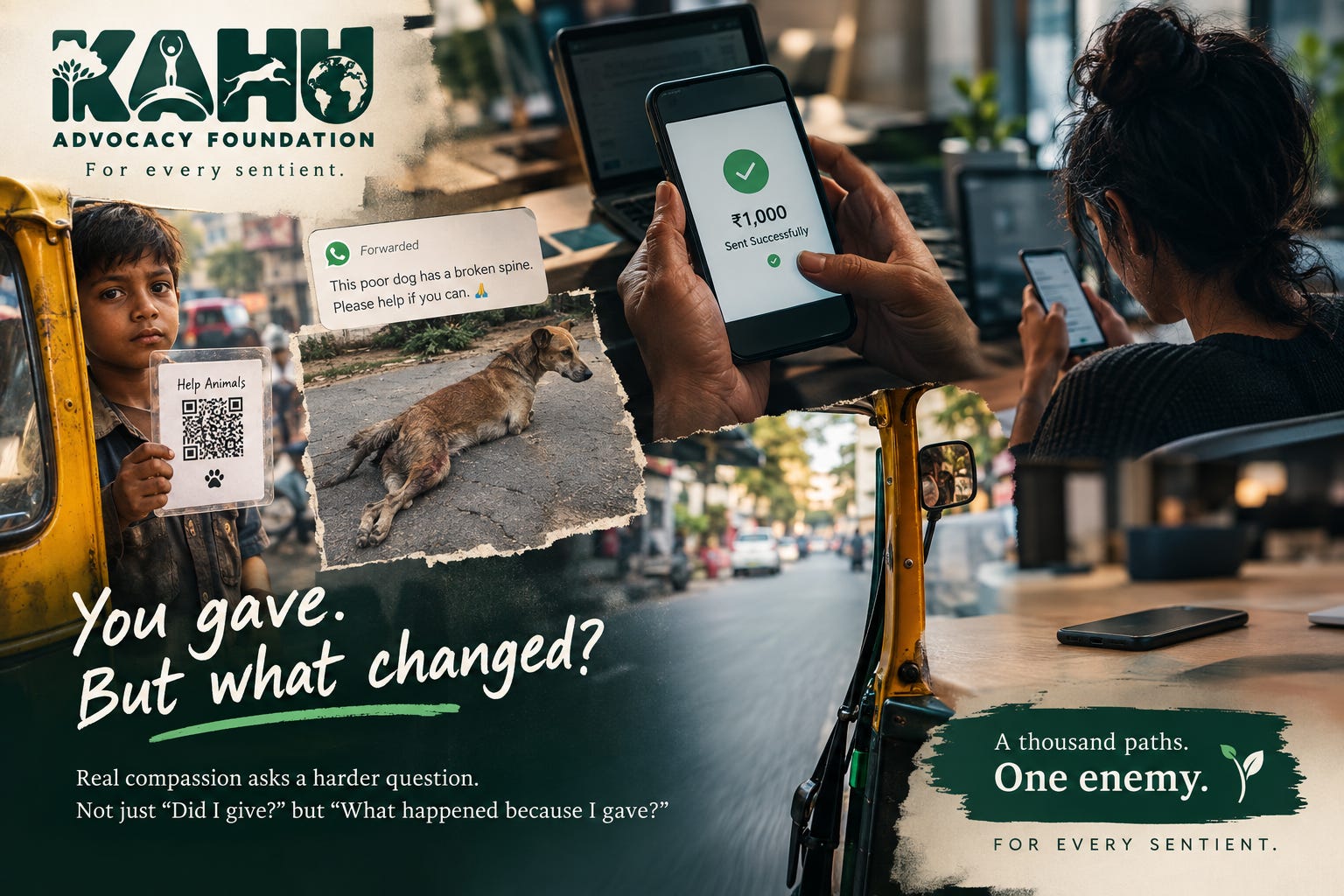
A tap sounds against the yellow metal frame. You look out. A young boy holds up a laminated QR code. Or perhaps it is a different day and you are sitting in the air-conditioned quiet of a corporate office, scrolling through your phone, when a WhatsApp forward arrives. It shows a street dog with a broken spine, dragging its hind legs across the cracked asphalt of a highway.
You feel a sudden, sharp tightening in your chest. You open your banking app. You scan the code. You type in ₹1,000. You press send. A small green tick appears on the screen. A chime sounds.
We all know this sequence. It is the familiar rhythm of everyday compassion. You saw suffering, you felt a pang of responsibility and you parted with a fraction of your wealth to address it. Giving feels good. It feels like a minor absolution. But underneath that brief warmth lies a quiet, uncomfortable question, one we almost never ask because the answer is too difficult to look for.
What actually happened after the screen went dark?
We tend to think of charity as a simple transaction. But philanthropy is not a transaction you ever see completed. When you give ₹1,000 or ₹500 to an organization, you are buying a promise. You are hoping your money becomes medicine or a legal petition or a day of veterinary care or a meal.
Sometimes, it does. But sometimes, it becomes something else entirely.
Suppose your ₹1,000 goes to a large, well-established hospital that already has millions in its reserve funds. The surgery you wanted to support happens, yes. But it would have happened anyway. Your specific ₹1,000 did not cause the healing. It merely shifted numbers in an accounting ledger. Or suppose your money funds an awareness campaign. An NGO prints five thousand glossy pamphlets about environmental conservation. They are handed out outside a busy metro station. People take them because saying no requires more effort than taking them. Ten minutes later, those pamphlets line the bottom of a municipal dustbin, stained with chai spills and beetle-nut spit. The NGO reports to its donors that five thousand people were reached.
Activity is not impact. Movement is not progress. Ten thousand views on a social media post do not mean ten thousand people changed their diets, altered their consumption or stopped inflicting harm. Fifty volunteers gathering for a photograph in matching t-shirts does not mean suffering was reduced.
If you have limited money to give and you genuinely want to reduce the pain in the world, the important question is not whether you donated. The important question is what happened because you donated.
On the 13th of September 2025, Kahu Advocacy Foundation was registered as a Section 8 nonprofit in India. We did not start this organization because the country has a shortage of charities. There are thousands of groups doing deeply compassionate work. We started KAHU because we wanted to build a place where the difficult questions of effectiveness are asked out loud, without defensiveness and without ego.
Our broad objective is simple. We exist to reduce suffering for all sentient life. Our tagline is: For every sentient.
But a noble objective is not enough. Intentions do not stop pain. Only effective actions stop pain.
Imagine you have ₹1,000 to spare this month. Somewhere, a community animal needs treatment. Somewhere else, a person could be reached by a behavioral intervention that fundamentally changes how they view farmed animals. Somewhere else, a legal case could be meticulously researched to challenge a systemic cruelty. And somewhere else, ₹1,000 might accomplish absolutely nothing, poured into a campaign that sounds beautiful but has never been tested against reality.
How do you choose?
We are trying to answer that question. We do not look at the world and declare that our specific cause is the only one that matters. We do not ask you to abandon the issues that keep you awake at night. People care about wildly different things. You might care deeply about the invisible misery of farmed animals locked in sheds on the outskirts of kolkata. Your sister might care about reproductive autonomy for young women in tier-two cities. Your neighbor might be advocating for adoption, or end-of-life dignity or childfree living or the quiet suffering of wildlife.
These look like entirely different battles. But they are bound together by a single thread.
A thousand paths. One enemy.
The enemy is suffering. The cause area is simply the geography where the battle takes place. KAHU can bring these disparate paths into one framework by asking a unifying question: among all the ways we could spend our time and money, which ones actually work?
This brings us to a central philosophical principle at KAHU. Suffering is the enemy, not the method.
It is easy for activists to fall in love with their own methods. We start believing that because our cause is righteous, anything done in its name is justified. But if the objective is truly to reduce suffering, the methods matter entirely. If a loud, angry protest at Sealdah or Victoria memorial does not change a single law or alleviate a single ounce of pain, we must be willing to admit it. If sitting in a quiet, tubelight-lit government office negotiating a small, unglamorous policy tweak saves ten thousand animals, we must do that instead.
We cannot be attached to the romance of the struggle. We must be attached to the results.
When you start looking for genuine, counterfactual impact, the world becomes a much more complicated place.
What is ₹1,000 today? It is perhaps a dinner at a restaurant with friends. It is a couple of online purchases you forget about before the delivery agent rings the bell. It is the smell of a multiplex lobby and a tub of popcorn.
But when pooled together with intention, the math changes. Ten people giving ₹1,000 a month is ₹10,000. A hundred people is ₹1,00,000. A thousand people is ₹10,00,000.
We will not insult your intelligence by pretending that scale automatically equals impact. A bad intervention funded by a million rupees is just a very expensive bad intervention. The scale only matters if the underlying engine works.
If you decide to set up a recurring donation of ₹1,000 a month to KAHU, you are not buying a guaranteed outcome. We will never put up a billboard claiming that your ₹1,000 saves exactly fifteen lives. That kind of fake precision is designed to market a feeling, not to reflect reality. The evidence is rarely that clean.
Instead, based on available evidence, an additional ₹1,000 may plausibly contribute to something far more structural. It buys KAHU the capacity to investigate. It pays for the unglamorous administrative stability required to run a proper experiment.
Perhaps we test a community outreach program on vegan behavior change. We run it. We measure it. And perhaps we find out it completely failed.
If it fails, we will say so. We will publish the failure. We will explain why it did not work. And we will never waste your money on it again. That, too, is a victory. Knowing what does not work is the only way to eventually find what does.
We are an experiment. We are a young organization trying to build a culture of intellectual honesty in a sector that often survives on emotional manipulation. We want to know the true cost-effectiveness of our actions. We want to know if volunteer leverage is better spent drafting right-to-information requests or conducting on-ground surveys.
The truth is, we do not know everything. Measurement is deeply imperfect. You cannot perfectly quantify the relief a street dog feels when a festering wound is finally cleaned. You cannot put a precise numerical value on the peace of mind a person gains when they are granted reproductive autonomy. Suffering is subjective, hidden and sprawling.
But the difficulty of measurement does not eliminate the responsibility to try.
We cannot calculate every ache and fear into a neat spreadsheet. That does not mean we throw our hands up and distribute funds blindly. We can still ask: How much did this cost? What alternatives existed? How long did the effect last? What did we learn?
There are two models of charity. The first model says: I donated, therefore I helped. The second model says: I donated, so what changed because of that money?
We are asking you to step into the second model. It is less comfortable. It lacks the immediate, uncomplicated warmth of the first.
It requires patience. It requires reading reports instead of just looking at photographs.
But it is the only way to ensure your generosity actually reaches the dark places it is meant for.
Maybe a ₹500 or ₹1,000 is not enough to change the entire world. Perhaps that is simply the wrong question to ask. The question is what ₹1,000 can change, and whether we are willing to put in the rigorous, unglamorous work to find out.
KAHU is trying to find out. We are building the infrastructure to test, to measure, to adapt, and to act.
We cannot guarantee that every experiment will succeed. We cannot know the future. But we can categorically refuse to stop asking what our money accomplishes. We can refuse to accept activity as a substitute for impact.
If you have any amount to spare, let us see what we can make it do.
A thousand paths. One enemy.
For every sentient.
Join the conversation